

Bad shin guards cost you more than money. They cost you training time, confidence in sparring, and the ability to develop your technique properly. The right pair lets you train hard, spar safely, and build the conditioning that Muay Thai demands. This guide covers everything you need to know to choose the best Muay Thai shin guards in the UK for your level, training style, and budget.

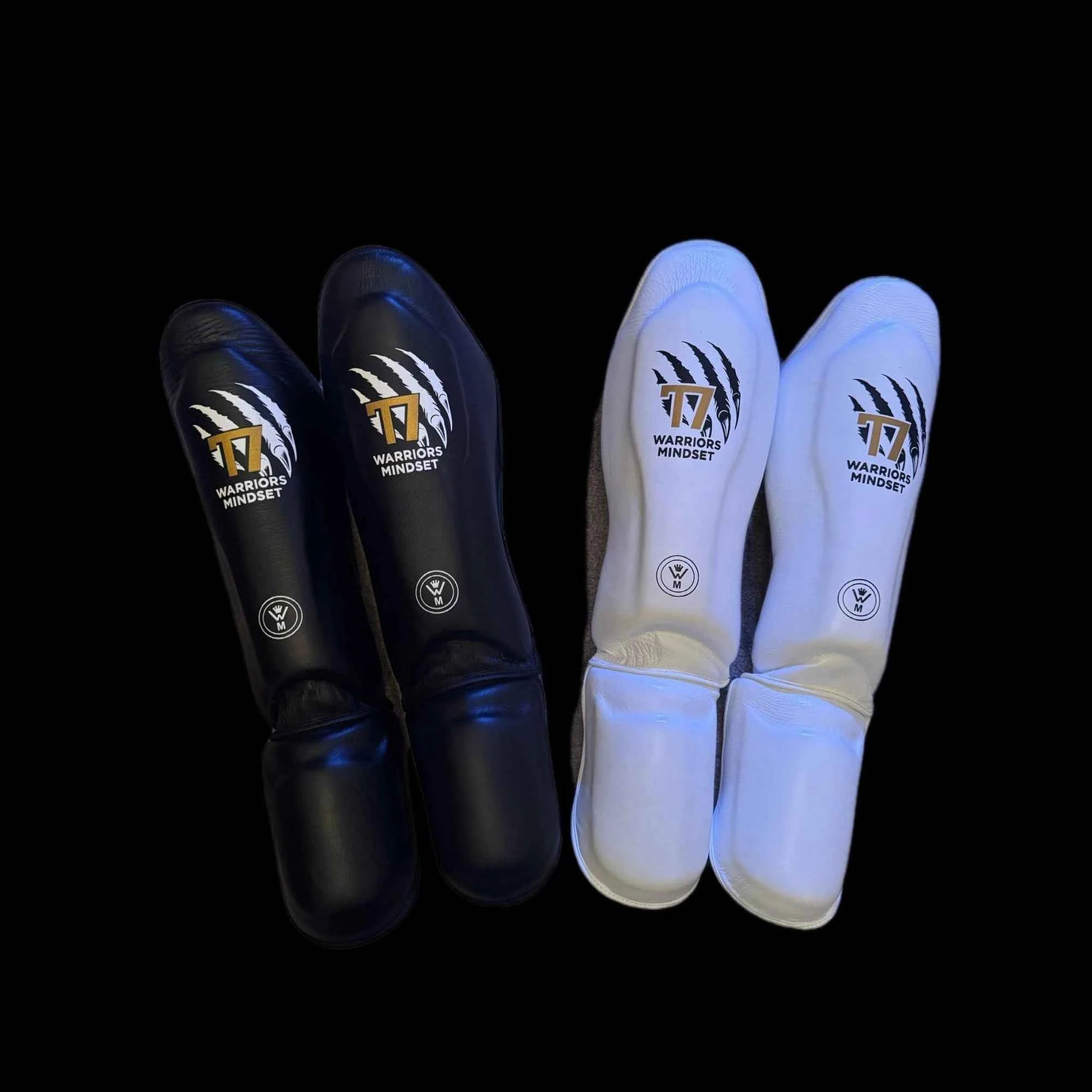
Warriors Mindset Leather Shin Guards
Real-leather construction, full shin and instep coverage, twin-strap fit. Built for Muay Thai sparring and serious training.
Shop now - £70At a glance - our top picks
| Pick | Best for | Material | Price | |
|---|---|---|---|---|
| Leather Shin Guards | Muay Thai sparring, serious training | Real leather | £70 | Shop |
| Heavy Sparring Shin Guards | Heavy bag/pad work, training partner safety | Synthetic | £50 | Shop |
| 10oz Gloves + Shin Guards Set | Beginners, fitness training, matching kit | Synthetic (set) | £79.99 | Shop |
Free UK delivery on every order. Dispatched within 1 working day.
Why Shin Guards Are Essential for Muay Thai
Muay Thai is a sport built on leg kicks. Whether you are drilling round kicks on the pads, sparring at full technique, or working sweeps and clinch counters, your shins and feet are constantly in contact with partners and equipment. Without proper protection, that contact leads to bruising, hairline stress injuries, and time off the mats.
Shin guards serve three purposes in training:
1. They protect you from your partner's blocks and counters. 2. They protect your partner from the full force of your kicks. 3. They allow you to throw techniques at genuine speed and power without either person pulling back.
That third point matters most. Fighters who train without proper shin guards develop a habit of softening their kicks in sparring. The technique becomes hesitant. The hips do not rotate fully. The follow-through shortens. Over time, the gulf between pad work and sparring widens in a way that is difficult to undo.
There is a common misconception in Muay Thai gyms: the idea that training without shin guards toughens the bone faster. Shin conditioning is real, but it happens through progressive loading over years, not through avoidable impact during sparring. Wearing guards does not slow your conditioning. Training more often, hitting pads more frequently, and staying injury-free does. Good shin guards keep you on the mat, and that is where the conditioning happens.
Types of Shin Guards for Combat Sports
Not all shin guards are the same, and the differences matter when you are training Muay Thai specifically.
Muay Thai shin guards are the standard for this sport. They offer full shin coverage from just below the knee to the top of the foot, with a padded instep section that protects during teeps, foot sweeps, and low kicks. The padding is dense rather than foam-soft, built to absorb repeated round kick impact at sparring intensity.
MMA shin guards are typically smaller and lighter. They prioritise mobility for grappling and allow the ankle to move freely for shooting takedowns. The trade-off is reduced coverage and thinner padding. In a Muay Thai context, these guards leave the lower shin and instep exposed, which makes them unsuitable for serious stand-up sparring.
Instep-only guards are not shin guards at all. They cover the top of the foot for drilling but offer no protection during full technique work. Some fighters use them on the pads for speed training, but they are not a substitute for proper sparring guards.
For Muay Thai, the choice is straightforward: use Muay Thai-specific guards with full shin and instep coverage. Anything less limits your training.
Leather vs Synthetic Shin Guards: Which Are Better?
The material debate is genuine, and the answer depends on what stage you are at in your training.
Leather shin guards are the long-term preference of serious Nak Muay for clear reasons. Full-grain leather moulds to the shape of your shin over time, creating a fit that synthetic materials cannot replicate. The outer shell is more resistant to abrasion from repeated contact, and the stitching holds up to the heat and sweat of regular training. A quality leather guard maintained properly will outlast several generations of synthetic alternatives.
The trade-off is the break-in period. New leather guards are stiff, and it takes several sessions before they sit comfortably against the shin. They also cost more at the point of purchase, though the cost-per-use over their lifespan is almost always lower.

Synthetic shin guards use polyurethane or PU leather construction. They are lighter out of the box, require no break-in period, and are typically easier to wipe clean. At entry level, they offer good coverage for a lower initial outlay. The limitation is durability: the synthetic outer layer degrades faster under hard training, the stitching can separate at stress points, and they tend to retain heat and moisture more than leather.
The verdict: if you are training three or more times per week and sparring regularly, leather is the correct investment. If you are starting out or on a strict budget, a quality synthetic guard is a workable stepping stone, provided the coverage and padding meet Muay Thai standards.
Browse all Shin GuardsHow to Choose the Right Size Shin Guards
Fit is as important as material. A guard that is too short leaves the lower shin exposed. One that is too long restricts knee bend, reduces mobility, and throws off your balance during kicks and footwork.
Measuring for shin guards:
Measure from just below the kneecap to the point where your shin meets the top of your foot (the ankle joint). This is your shin length and the primary sizing reference.
| Shin Length | Size |
|---|---|
| Under 35 cm | Small |
| 35 to 40 cm | Medium |
| 40 cm and above | Large |
Common fit problems to avoid:
- The guard slides down during training. This usually means the size is too large or the straps are not positioned correctly. The upper strap should sit just below the knee, not over it.
- The guard restricts knee bend. The top of the guard is sitting too high, either due to incorrect sizing or because it has slipped upward during movement. Adjust the upper strap lower.
- The instep pad does not reach the toe line. The guard is too small. The instep should cover the top of the foot fully for proper protection during teeps and foot sweeps.
When trying shin guards for the first time, kick a target with your foot, throw a teep, and perform a lateral step. If any movement feels blocked or the guard shifts more than a centimetre, the fit needs adjustment.
Save with the matching set
If you also need gloves, our 10oz Boxing Gloves & Shin Guards Set covers both in five matching colourways for £79.99 - less than buying gloves and shin guards from different brands.
View the matching setBest Shin Guards for Muay Thai Sparring in 2026
Warriors Mindset covers two primary options for sparring-level training, plus a matching kit option for beginners.
Warriors Mindset Leather Shin Guards
Real-leather construction, full shin and instep coverage, twin-strap fit. The pick if you're sparring three or more times a week.
- Real leather shell - outlasts synthetic 2x
- Full instep cover, twin-strap closure
- Sized S, M, L
The Leather Shin Guards are constructed from full-grain leather with layered foam padding throughout the shin panel and a separate instep section that wraps around the foot without restricting ankle movement. The velcro strapping system uses reinforced backing at the attachment points, which is where cheaper guards typically fail first.
These guards suit fighters who train consistently and want protection that lasts. The break-in period runs approximately three to five sessions before the leather softens and conforms to the shin. After that, the fit is precise.
Warriors Mindset Heavy Sparring Shin Guards
Extra-dense padding for hard sparring and bag work. Protects both you and your training partner at full power.
- Thicker central shin panel for blocked kick impact
- Reinforced instep padding
- Sized S, M, L
The Heavy Sparring Shin Guards are built for fighters who spar hard or who train with partners who hit with significant power. The padding layer is thicker throughout, with additional density in the central shin panel where blocked kicks land most frequently.
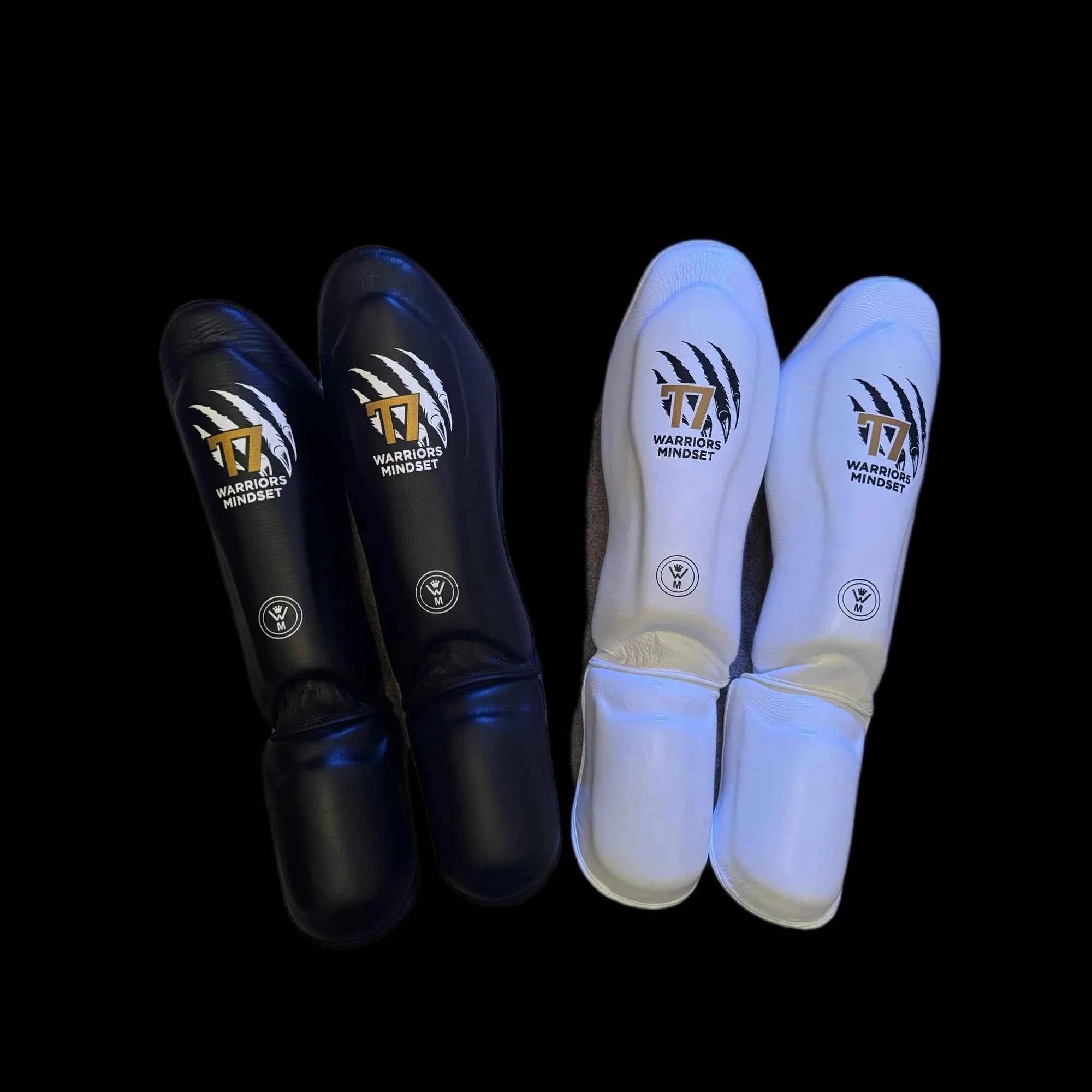
The trade-off for the extra protection is weight. These guards are heavier, which some fighters find affects the snap on their kicks during extended sparring. For most people training at the recreational to intermediate level, that is not a relevant concern. Both options ship with free UK delivery from Bournemouth.
Best Matching Kit for Beginners - Warriors Mindset 10oz Boxing Gloves & Shin Guards Set
If you're buying your first proper kit and you also need gloves, the 10oz Set covers both in five matching colourways for £79.99. The shin guards in the set are sized identically to our standalone synthetic option but come paired with 10oz boxing gloves cut for pad work, bag work and combat fitness training. It's the cheapest matching gloves and shin guards bundle on the UK market.
Important: 10oz gloves are not sparring-grade (UK gyms typically require 14oz+ for adult sparring). The set is the right tool for fitness, pad and bag training. For sparring nights, pair with our Leather Shin Guards and 16oz gloves.
Warriors Mindset 10oz Boxing Gloves & Shin Guards Set
Gloves and shin guards in one bundle, five matching colourways. The cleanest entry point for beginners.
- 10oz gloves + shin guards matched
- Five colourways
- Pad work, bag work, fitness training
Best Shin Guards for Beginners
If you are new to Muay Thai, the priority list when choosing shin guards is different from an experienced fighter's.
Coverage first. A beginner has not yet developed the muscle memory to control distance reliably or to brace efficiently for blocked kicks. Full coverage, from knee to instep, is non-negotiable. Do not compromise here to save money.
Padding depth over weight savings. Lighter guards exist for competition and high-level technical drilling. As a beginner, you benefit far more from dense padding that absorbs impact than from a guard that adds speed to a kick you are still learning to throw correctly.
Secure strapping. Guards that shift during movement are a distraction and a safety issue. Two-strap systems with reinforced velcro backing hold position better than single-strap alternatives.
Budget reality. Quality beginner shin guards sit in a range that represents genuine value over time. Buying the cheapest available option often means replacing them within six months as the padding compresses and the outer shell deteriorates.
Beginners should also consider completing their sparring kit. Muay Thai Elbow Pads and Muay Thai Shorts UK are the natural companion purchases when setting up for full sparring training.
For a full overview of what you need when starting out, the Muay Thai Equipment Guide covers every piece of kit from gloves to ankle supports. If you're also looking for the right pads for your training partner, see our Muay Thai Pads UK guide.
How to Break In and Maintain Your Shin Guards
Leather shin guards require attention to perform and last. Neglecting them is the most common reason quality guards fail before their time.
Breaking in new leather guards:
New leather is stiff. Do not try to accelerate the process by soaking the guards in water or applying excessive conditioner before the first session. Instead, wear them for pad work and light drilling for the first three to five sessions. The leather will soften through body heat and natural movement. Apply a small amount of leather conditioner to the exterior after each of the first few sessions to prevent cracking during this process.
Cleaning after training:
Sweat degrades leather and breeds bacteria that cause odour and surface deterioration. After every session, wipe the exterior down with an antibacterial spray or a cloth dampened with diluted tea tree oil. Do not saturate the leather. Open the velcro straps and leave the guards open, not bunched together.
Storage:
Never leave shin guards in a closed gym bag. The heat and moisture trapped inside a bag accelerates deterioration faster than training does. Store them in a ventilated area, open and separated. A boot dryer on a low setting works well for removing residual moisture after heavy sessions.
Extending lifespan:
Apply leather conditioner every four to six weeks depending on training frequency. Check the stitching at the strap attachment points regularly. Minor fraying caught early can be repaired. Stitching that separates fully requires professional repair or replacement.
Synthetic guards require less maintenance but benefit from the same ventilation and cleaning habits. The outer material does not respond to conditioner, but wiping them down after every session and allowing them to dry fully before storage meaningfully extends their working life.
Frequently Asked Questions
What size shin guards should I get?
Most adult fighters fit M. Order S if you're under 65kg or have smaller calves; L if you're over 85kg or have larger calves. Both leather and synthetic versions size the same way.
Most popular size: our Leather Shin Guards in M.
Shop the M sizeShould I get heavy or lightweight shin guards?
For sparring, choose heavier guards with dense padding to protect both you and your partner. For pad work and drilling, lighter guards allow better speed and technique. If you can only afford one pair, go with the heavier option.
For hard sparring, the Heavy Sparring Shin Guards are the right call.
Shop Heavy Sparring GuardsHow do I stop my shin guards from smelling?
Air them out immediately after every session. Never leave them in your bag. Wipe them down with antibacterial spray or diluted tea tree oil. Store them open in a ventilated area. Consider using a boot dryer or stuffing them with newspaper to absorb moisture.
Do I need gloves as well as shin guards?
Yes - for Muay Thai sparring you need both. If you're buying your first kit, our 10oz Gloves and Shin Guards Set covers both for £79.99 in five matching colourways.
View the matching setOur top picks at a glance
Three shin guards, three different jobs. If you're sparring three times a week, the Leather Shin Guards are the long-term pick - real leather outlasts synthetic and the protection holds up. If you're heavy on bag and pad work and care about training partner safety, the Heavy Sparring Shin Guards add the extra padding without changing how the strap sits. If you're building your first kit and want gloves to match, the 10oz Set is the cleanest entry point.
Free UK delivery on all orders. Need help choosing? Drop a message in the chat with your weight and discipline and we'll match you.


